Tuesday, September 27, 2016

A Portrait of God by Daniel Chamberlin

Daniel Chamberlin's book A Portrait of God is now available at Free Grace Press. Here is the description of the book on the website:
Stephen Charnock's Discourses Upon the Existence and Attributes of God is a classic, but is over 500 pages. Daniel Chamberlin has done the church a service by summarizing the essential thoughts of Charnock on the doctrine of God for the 21st Century reader.
This is a great tool for groups to work through together, as each chapter is nicely divided up into bit size portions.
Jeff has highly recommended it to me, and I look forward to reading it myself. Please let us know what you think here at the Reformed Baptist Blog after you've had a chance to read it yourselves. If you are interested in digging deeper into Charnock's work, you can get the free eBook of his Discourses Upon the Existence and Attributes of God here. I think you will quickly appreciate why an introductory, summary work such as A Portrait of God can be so helpful, especially if you are trying to acquaint others with such theology.

Thursday, September 22, 2016

"Abortion" by Randy Alcorn

I am planning to attend a fundraising dinner tonight for the Pregnancy Resource Center here in Bloomington-Normal, Illinois, an organization that has been used of God to bring many to salvation through Jesus Christ our Lord and to save the lives of many unborn children as well. As I was thinking about the issue of abortion again -- an issue I have taken to praying about every day -- I was also doing some extra reading on the subject and ran across an article by Randy Alcorn at the Ligonier website entitled Abortion. In the article Randy does an excellent, succinct job of explaining the Scriptural view that abortion is indeed murder. Here is the first part of the article:
Some “pro-choice” advocates claim to base their beliefs on the Bible. They maintain that Scripture does not prohibit abortion. They are wrong. The Bible does, in fact, emphatically prohibit the killing of innocent people (Ex. 20:13) and clearly considers the unborn to be human beings worthy of protection (21:22–25).
Job graphically described the way God created him before he was born (Job 10:8–12). That which was in his mother’s womb was not something that might become Job, but someone who was Job—the same man, only younger. To the prophet Isaiah, God says, “Thus says the Lord who made you, who formed you from the womb and will help you” (Isa. 44:2). What each person is, not merely what he might become, was present in his mother’s womb.
Psalm 139:13–16 paints a vivid picture of God’s intimate involvement with a preborn person. God created David’s “inward parts” not at birth, but before birth. David says to his Creator, “You knitted me together in my mother’s womb” (v. 13). Each person, regardless of his parentage or handicap, has not been manufactured on a cosmic assembly line, but personally formed by God. All the days of his life are planned out by God before any come to be (v. 16).
Meredith Kline observes: “The most significant thing about abortion legislation in Biblical law is that there is none. It was so unthinkable that an Israelite woman should desire an abortion that there was no need to mention this offense in the criminal code.” All that was necessary to prohibit an abortion was the command, “You shall not murder” (Ex. 20:13). Every Israelite knew that the preborn child was a child. So do we, if we are honest. We all know a pregnant woman is “carrying a child.”
Please consider taking a few minutes to read the rest of this article, and please prayerfully consider what you may do to help stop abortion in any way that you can.

Tuesday, September 13, 2016

Helpful Responses to Andy Stanley's Aberrant Teaching

Many of you may be familiar with my own challenges to the teaching of Andy Stanley in a previous blog post entitled Is Andy Stanley Ashamed of the Bible? In that post I offered a critique of three of Andy's sermons and demonstrated how his disdain for expository preaching derives from a different view of Scripture. In fact, I have come to believe that Andy has departed from the orthodox faith in regard to the authority and sufficiency of Scripture, and his more recent assertions have only reinforced this belief. In light of these more recent assertions and teaching, then, I would recommend reading my previous post if you have not already done so, for in it I challenge many of the very kinds of things he has been continuing to say. But I would also like to recommend listening to the critique offered by James White (pictured right), which is contained in the videos below, as well as reading some recent articles over at the Pulpit & Pen blog, which are linked at the bottom of this post.

In order to set the table, many of you may already be familiar with Andy's recent comments made in an interview with Russell Moore. Here is the video containing the relevant comments:


In the Dividing Line video below, at about the 30 minute mark, James White begins to discuss Andy's statements. He challenges Andy's assertions in the interview, as well and some other statements made by him on his church's website. He also does a very good job of working through 1 Corinthians 1 and demonstrating the difference between Andy's perspective and that of the Apostle Paul.


In the next video below, James responds to Andy's sermon entitled The Bible Told Me So, the third part of a series entitled "Who Needs God," in which Andy continues to make the same kind of silly argument I had challenged in the sermons I had previously critiqued. Here is the description of the episode from the Dividing Line website:
There were three major topics on the DL today (after the opening discussion of some urgent situations where the people of God need to bring certain issues before the throne of grace): first, an article published today on Revelation 16:5 and the Textus Receptus; then, a rather lengthy review of Andy Stanley’s sermon from Sunday on the Bible and Christianity. About 2/3 of the way through we were joined by Dr. Tony Costa on the phone, but we pressed on and finished the sermon, commenting as we went along.  And then in the last half hour or so Tony and I discussed the double standards so often used by Islamic apologists. Two and a half hours long! Have the days of hour long Dividing Lines ended? Tune in next week to find out!
As you can see, James had as hard a time being brief in his critique of Andy as I did! But it is well worth listening to the entire critique, which begins at about the 41:30 mark.


James does a good job of pointing out the theological issues with Andy, not to mention the fact that he simply doesn't know what he is talking about in much of what he says (unless he is deliberately distorting the most basic facts of Church history). At any rate, we need to warn our brothers and sisters in Christ about the real danger of ignorant, liberal, unorthodox teachers like Andy Stanley, and I appreciate James so ably helping us in this regard.

I also appreciate the efforts of Bud Ahlheim over at the Pulpit & Pen blog, who has written a series of recent posts about these issues:
SBC Conference: “Get The Spotlight Off The Bible” (Courtesy of Russell Moore & Andy Stanley)
Superstar Mega-church Son of A (Hopefully Ashamed) Preacher Man Andy Stanley: Scripture Can’t Be Defended  
Andy Stanley: You’re Not Smart Enough If You’re Not In “One of Our Churches” (Doubling Down on Unnecessary Scripture)
Although I would have stated a few things a bit differently, I certainly agree with Bud's conclusions regarding Andy's view of Scripture and the Church. As always, we welcome your comments.

Wednesday, September 07, 2016

2016 "What is a Reformed Baptist?" Poll September Update

Eight months ago we began a poll on the blog. If you identify yourself as a Reformed Baptist and you haven't already taken part in the poll, please check out the "What is a Reformed Baptist?" Poll on the right sidebar on this page (the red box with white type). The intention is to run the poll for one year with an interest in how the Reformed Baptist community might answer this question. I have given four options for answers that I think basically sum up the various groups or individuals that I have found to be using the term. Here are the four possible answers:
To regard oneself as a Reformed Baptist, one must ...

1) adhere at a minimum to a Calvinistic soteriology.

2) adhere at a minimum to a Calvinistic soteriology and to Covenant Theology.

3) adhere substantially to the Baptist Confession of 1689 (e.g. modify regarding Impassibility).

4) adhere strictly to the Baptist Confession of 1689.
For those interested, here are the results thus far:
13% say that one must adhere at a minimum to a Calvinistic soteriology in order to be regarded a Reformed Baptist.

25% say that one must adhere at a minimum to a Calvinistic soteriology and to Covenant Theology in order to be regarded a Reformed Baptist.

43% say that one must adhere substantially to the Baptist Confession of 1689 (e.g. modify regarding Impassibility) in order to be regarded a Reformed Baptist.

19% say that one must adhere strictly to the Baptist Confession of 1689 in order to be regarded a Reformed Baptist.
Again, if you haven't yet taken part in the poll, please do so. You may read more about the poll here in order to understand better why it is phrased as it is.

Wednesday, August 31, 2016

Free eBook of Old Paths by J.C. Ryle

I have discovered that Monergism.com has made available the free eBook of Old Paths: Being Plain Statements On Some Of The Weightier Matters Of Christianity. You may download it here in ePub, .prc (Kindle) or .pdf formats. Here is a selection from the preface, in which Ryle explains his purpose:
“If the trumpet give an uncertain sound, who shall prepare himself to the battle?” - 1 Corinthians 14:8
The volume now in the reader’s hands consists of a series of papers, systematically arranged, on the leading truths of Christianity which are “necessary to salvation”.
Few, probably, will deny that there are some things in religion about which we may think other people hold very erroneous views, and are, notwithstanding, in no danger of being finally lost. About baptism and the Lord’s Supper, about the Christian ministry, about forms of prayer and modes of worship, about the union of Church and State, about all these things it is commonly admitted that people may differ widely, and yet be finally saved. No doubt there are always bigots and extreme partisans, who are ready to excommunicate everyone who cannot pronounce their Shibboleth on the above-named points. But, speaking generally, to shut out of heaven all who disagree with us about these things, is to take up a position which most thoughtful Christians condemn as unscriptural,narrow, and uncharitable.
On the other hand, there are certain great truths of which some knowledge, by common consent,appears essential to salvation. Such truths are the immortality of the soul, the sinfulness of human nature, the work of Christ for us as our Redeemer, the work of the Holy Ghost in us, forgiveness,justification, conversion, faith, repentance, the marks of a right heart, Christ’s invitations, Christ’s intercession, and the like. If truths like these are not absolutely necessary to salvation, it is difficult to understand how any truths whatever can be called necessary. If people may be saved without knowing anything about these truths, it appears to me that we may throw away our Bibles altogether, and proclaim that the Christian religion is of no use. From such a miserable conclusion I hope most people will shrink back with horror.
To open out and explain these great necessary truths, to confirm them by Scripture, to enforce them by home, appeals to the conscience of all who read this volume. This is the simple object of the series of papers which is now offered to the public.
The eBook was actually produced by the folks at PreachtheWord.com, who have done a good job creating a very mice-looking and easily navigated eBook. They also have a number of other such sources freely available here.

Wednesday, August 24, 2016

Joy Comes in the Mourning


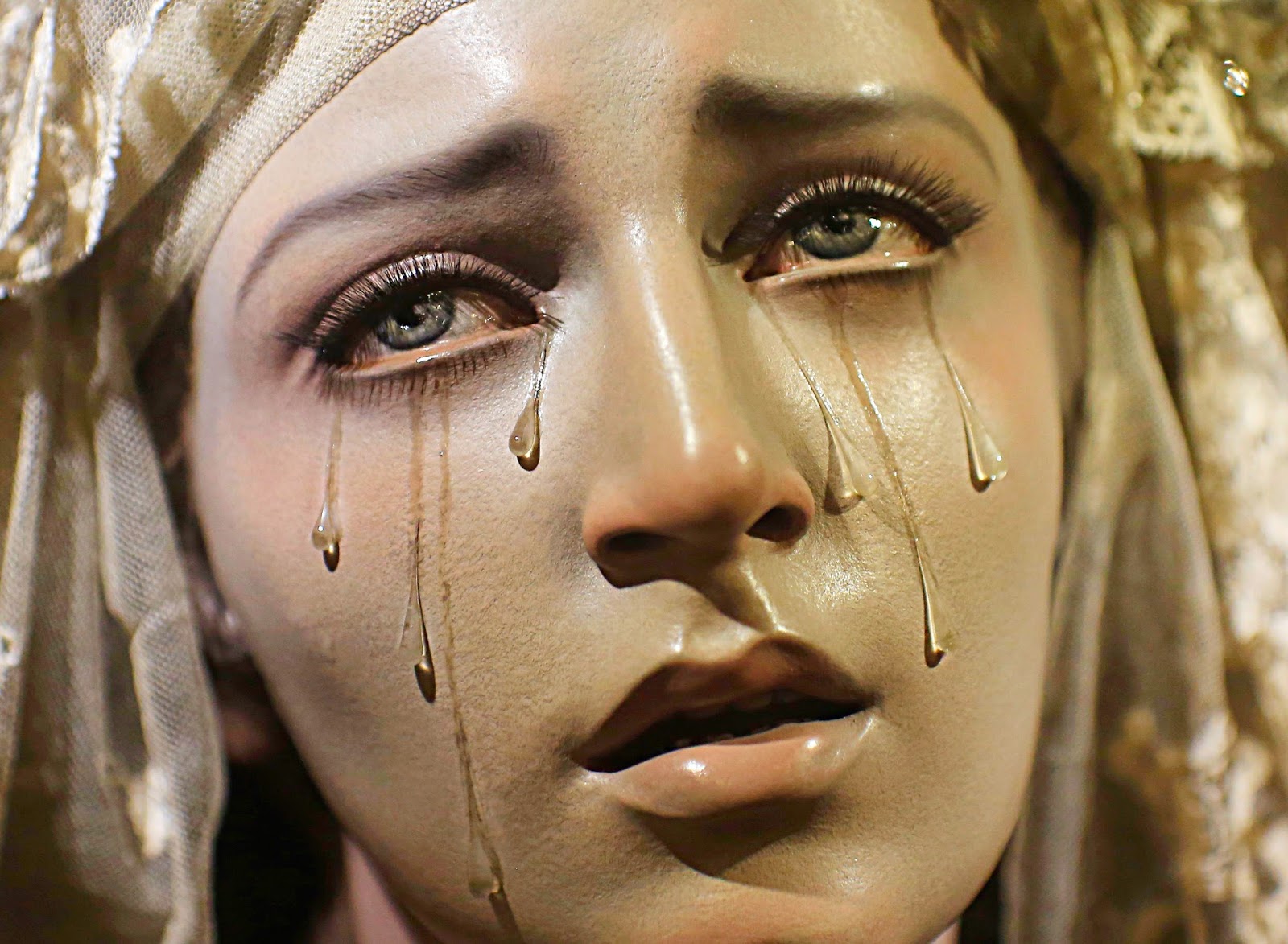
Do you know what it’s like to feel the sorrow of a bereaved mother? A mother’s life is wrapped up in the care and well-being of her children. When those children are taken away from her or, worse, when they’re wantonly slaughtered before her eyes, it’s like ripping out her heart. She feels empty. She feels as if she no longer has any purpose for existence. Perhaps you’re experiencing that kind of grief. You’ve not been bereaved of your children, but you feel the same kind of empty sorrow. You feel hopeless and without purpose in the world.

But there is hope if you will believe the good news about Jesus Christ. Weeping may endure for the night, but joy will come in the “mourning.” That’s one of the biblical themes that the apostle Matthew highlights in his Gospel account. Let’s reflect on how Matthew develops this theme in the second chapter of his Gospel.

The Slaughter of Bethlehem’s Children

When most people think of birth of Christ and the little town of Bethlehem, they have in mind a beautiful and peaceful scene—shepherds and wise men worshiping the young Christ. But that is not the whole picture. Matthew would remind us that from the very beginning, there was much hatred aimed at the Lord Jesus Christ—hatred that resulted in the shedding of innocent blood!

In the second chapter of his Gospel, Matthew records an event that followed the birth of Christ: the slaughter of Bethlehem’s children. According to verse 7, Herod had learned from the wise men when the star first appeared. Then, once he realized that the wise man had become privy to Herod’s scheme and escaped, he calculated the time elapsed from the appearing of the star, and he sent his soldiers to slaughter every male child two years and under.
Then Herod, when he saw that he had been tricked by the wise men, became furious, and he sent and killed all the male children in Bethlehem and in all that region who were two years old or under, according to the time that he had ascertained from the wise men (Matt 2:16 ESV).
Matthew’s portrait of Herod accords well with secular history. History portrays Herod as a very gifted and capable leader, which is one of the reasons he was called “Herod the Great.” In his lifetime, he had many achievements to boast to his credit. But Herod was also a very cunning and cruel ruler. During the latter years of his rule, Herod became very suspicious that someone would usurp his throne. In fact, we’re told that he had three of his seven sons murdered, as well as one of this wives, because he suspected them of treason. For this reason, the Roman Emperor is reported to have said: “Better to be Herod’s pig [hus] than his son [huios].”

So it should be no surprise us to see Herod responding this way to the news that the King of the Jews has been born. Bethlehem’s population was probably under 1000 people, which, according to statistics, would put the number of baby boys slaughtered at around 20-30. Can you imagine such a horrible scene? Why would Matthew include such a gory scene in his gospel?

Not Everybody Loves Jesus

Commenting on this text, J. C. Ryle notes that Christ is portrayed as “‘a man of sorrows’ even from his infancy.”[1] Don’t let the sweet little Nativity Scenes fool you. Here’s the “rest of the story”: not everybody loves Jesus. And there are still people today who, like Herod, would rather murder the Christ than worship Him.

What’s more, if you’ve been a Christian for very long and if you’ve made a public commitment to Christ, you know about the opposition. You’ve experienced the truth underscored by the apostle Paul: “All who live godly in Christ Jesus shall suffer persecution” (2 Tim 3:12).

The End of Rachel’s Tears

There is another reason why Matthew includes this tragic incident. According to verses 17 and 18, this gruesome event was no mere accident, but it happened in order to fulfill OT Scripture:
Then was fulfilled what was spoken by the prophet Jeremiah: ”A voice was heard in Ramah, weeping and loud lamentation, Rachel weeping for her children; she refused to be comforted, because they are no more” (Matt 2:17–18 ESV).
Ramah was a city located on the border between Ephraim and Benjamin, about 5 miles north of Jerusalem and 10 miles north of Bethlehem. This is significant, because Ephraim was part of the Northern kingdom and Benjamin was part of the Southern kingdom. According to Jeremiah 40:1, the city of Ramah was used as a staging place for the deportation of God’s people into captivity. Rachel was one of Jacob’s wives. She had two sons: her first son was Joseph, to whom was born Ephraim. Her second son was Benjamin.

The Tragedy of the Exile

But Rachel has been dead for over 1,000 years. How could she be weeping? Obviously, Jeremiah is using figurative language to portray Rachel as the mother of the nation—Ephraim represents the north and Benjamin represents the south. From the grave the mother of the nation weeps for her children, and she refuses to be comforted because they are no more!

Try to imagine what this would be like. Families are literally being tom apart. Husbands and wives are being exiled to separate locations. Brothers and sisters will never see one another again. Mothers are being separated from their children. What great sorrow and grief! As Matthew reflects upon the sorrow experienced by the mothers at Ramah and that experienced by the mothers at Bethlehem, he obviously sees a clear correspondence.

All Hope Seems Lost!

But the correspondence is much deeper than mere emotional grief. As you know, the hope of redemption was bound up in the promise of a male seed who would descend from the nation of Israel, from the tribe of Judah, and from the line of David.

But when the young men of Israel—especially the descendants of David—were lined up in Ramah to be exiled from the Land of Promise, all hope of redemption seemed to be lost! All hope of salvation forever vanished!

Joy Comes in the “Mourning”!

And yet, all is not hopeless! “Though weeping may endure for the night; joy comes in the morning” (Psa 30:5). And so, the Jeremiah assures God’s people:
Thus says the LORD: “Keep your voice from weeping, and your eyes from tears, for there is a reward for your work, declares the LORD, and they shall come back from the land of the enemy. There is hope for your future, declares the LORD, and your children shall come back to their own country” (Jer 31:16–17 ESV).
Jeremiah’s prophecy is not primarily a prophecy about sadness and grief. It’s primarily a message about joy and hope! In fact, as you know this chapter goes on to predict the coming of a New Covenant! (31:31-34). Yes, tears will precede the joy. But joy will come in the morning!

Jesus Wipes Away Tears

That’s Jeremiah’s message, and I believe Matthew’s point is that the “end of Rachel’s grief” portrayed by Jeremiah has come to fulfillment in the coming of the Messiah which began with the grief of Bethlehem’s mothers. In other words, the weeping mothers of Bethlehem do not merely recapitulate the sorrow experienced at Ramah. But they serve as a harbinger of the Messianic hope foretold by Jeremiah! As Donald Carson writes
The tears of the exile are being fulfilled—the tears begun in Jeremiah’s day are climaxed and ended by the tears of the mothers of Bethlehem. The heir to David’s throne has come, the Exile is over, the true Son of God has arrived, and he will introduce the new covenant promised by Jeremiah.[2]
Isn’t that glorious! Let me put it in more practical terms: Christ is the end of sadness and grief and He is the beginning of joy and hope to all who will believe. And that’s true for sinner and saint alike! Whoever you are, look to Christ and find joy in the midst of your mourning.
______________

[1] Expository Thoughts on the Gospels, 1:15.
[2] “Matthew” in vol. 8 of The Expositor’s Bible Commentary, 95.

Friday, August 19, 2016

A New Seminary


Note: Keith Throop here! Doing some blog maintenance and editing, I accidentally messed up and then had to delete my blog partner Jeff Johnson's post about the new seminary begun through the efforts of his church. I was able to post it again it myself, but, of course, I am not the pastor of Grace Bible Church of Conway, Arkansas. Perhaps Jeff can post it under his own account again later and delete this post. This means you will get yet another reminder about the seminary, but, hey, that is a good thing, right? Anyway, what follows is from Jeff!

Grace Bible Church of Conway, Arkansas, where I am privileged to pastor, is starting a church based seminary called Grace Bible Institute of Pastoral Studies. See here.

This is truly amazing. Planting the church over fifteen years ago in my living room, I never thought this would be something God had in store for us. We are thanking God for this great opportunity.

In some ways, the seminary has been forced on us. With more and more young men joining our church with a desire to minister and preach the Word, our responsibility to train them became more and more evident. I have felt for some time now that it is the local church’s responsibility to equip the next generations of pastors. 2 Tim. 2:2 teaches us that pastors are responsible to train pastors. After starting a class that would meet once a month, more pastoral students have been sent to us by God. With such a reservoir of men, and with God supernaturally supplying the financial resources, it became clear to us that we needed to start a more robust training program.

Our objective is to equip, ordain, and send out the next generation of church leaders by providing faithful men with a doctrinal education and pastoral experience within the context, oversight, and accountability of our local church. We not only desire to offer a rigorous education in the classroom, but supply practical, real-life experience under the mentorship of our pastors.

So we created a degree program that is based on four avenues of study. First, we are offering four module courses a year where we will bring in some of the leading professors in America. Over an extended weekend, our students will be able to earn 3 credit hours in a classroom setting. Second, we will provide four residential classes a year that are taught by the elders of the church—including myself. Third, we will require six credit hours of self study a year that will be guided and overseen by the Institute’s staff. Fourth, preaching and counseling practicums will be required throughout the program.

If you want to view our course list, check here.

Dr. Bob Gonzales taught our first module on the Doctrine of the Word, and Dr. Tom Nettles is scheduled to come and teach Baptist Church History next week. For more information on this, see here.

We desire to train pastors who self-sacrificially care for God’s sheep.

Though we are not currently accredited, our goal is to become affiliated and then accredited with the Association of Reformed Theological Seminaries.

If you would like to help us, we are seeking to build a robust theological library and would appreciate book donations. We are in the mist of the building construction of our new church and seminary facilities, and with limited wall space, we plan to build a 25 by 16 foot bookshelf with a spiral staircase and catwalk at the 8 foot mark. So, we need books.  

Most importantly, we could use your prayers as our goal is not to make a great name for ourselves, but to help ordain and send out laborers into the harvest.

Wednesday, August 10, 2016

2016 "What is a Reformed Baptist?" Poll August Update

Seven months ago we began a poll on the blog. If you identify yourself as a Reformed Baptist and you haven't already taken part in the poll, please check out the "What is a Reformed Baptist?" Poll on the right sidebar on this page (the red box with white type). The intention is to run the poll for one year with an interest in how the Reformed Baptist community might answer this question. I have given four options for answers that I think basically sum up the various groups or individuals that I have found to be using the term. Here are the four possible answers:
To regard oneself as a Reformed Baptist, one must ...

1) adhere at a minimum to a Calvinistic soteriology.

2) adhere at a minimum to a Calvinistic soteriology and to Covenant Theology.

3) adhere substantially to the Baptist Confession of 1689 (e.g. modify regarding Impassibility).

4) adhere strictly to the Baptist Confession of 1689.
For those interested, here are the results thus far:
14% say that one must adhere at a minimum to a Calvinistic soteriology in order to be regarded a Reformed Baptist.

25% say that one must adhere at a minimum to a Calvinistic soteriology and to Covenant Theology in order to be regarded a Reformed Baptist.

41% say that one must adhere substantially to the Baptist Confession of 1689 (e.g. modify regarding Impassibility) in order to be regarded a Reformed Baptist.

20% say that one must adhere strictly to the Baptist Confession of 1689 in order to be regarded a Reformed Baptist.
Again, if you haven't yet taken part in the poll, please do so. You may read more about the poll here in order to understand better why it is phrased as it is.

Friday, August 05, 2016

Parable of the Doorkeeper (Mark 13:32-37 Teaching Outline)

Note: In our previous examination of the Parable of the Budding Fig Tree, we saw that the disciples asked our Lord Jesus about the time when the destruction of Jerusalem would occur. We also saw that He gave them a two-part answer. The first part of His answer dealt primarily with the coming destruction of Jerusalem within the lifetime of that generation, but the second part of His answer dealt with His second coming. The Parable of the Budding Fig Tree was intended to go with the first part of Jesus’ answer about the coming destruction of Jerusalem. The Parable of the Doorkeeper, however, which we will examine today, was intended to go with the second part of Jesus’ answer about His second coming.
 
Introduction: The Apostle Paul wrote to the Philippian believers about the great mystery of the incarnation in this way:
NKJ Philippians 2:5-8 Let this mind be in you which was also in Christ Jesus, 6 who, being in the form of God, did not consider it robbery to be equal with God, 7 but made Himself of no reputation, taking the form of a bondservant, and coming in the likeness of men. 8 And being found in appearance as a man, He humbled Himself and became obedient to the point of death, even the death of the cross.
Paul later explicitly referred to the incarnation of Jesus Christ as a mystery:
NKJ 1 Timothy 3:16 And without controversy great is the mystery of godliness: God [θεὸς, NU = ὃς, He] was manifested in the flesh, justified in the Spirit, seen by angels, preached among the Gentiles, believed on in the world, received up in glory.
Today we are going to encounter one of the mysterious things about the incarnation of the Son of God, namely the mysterious way in which He was limited in His full humanity as our Messiah and Savior, yet remained fully God at the same time. For example, last week we saw how Jesus assumed His own complete divinity when He said, “Heaven and earth will pass away, but My words will by no means pass away” (vs. 31). Yet in the very next line He also assumes His own complete humanity when He speaks of the limitations of His knowledge in His role as our Messiah. We will see this as we examine 1) the context of the parable, 2) the communication of the parable, and 3) the application of the parable.
 
I. The Context the Parable
 
We find the context of the parable in verses 32-33.
NKJ Mark 13:32 But [δέ, here with strong adversative force meaning on the contrary] of that day and hour no one knows, not even the angels in heaven, nor the Son [i.e. the Son of Man, vs. 26], but only the Father. [See also Matt. 24:36, which does not include the words οὐδὲ ὁ υἱός, nor the Son.]
When Jesus spoke of “that day and hour,” He was referring to the timing of His second coming about which He had spoken in the second part of His answer to the disciples in verses 24-27. We know He cannot be referring to the first part of His answer about the coming destruction of Jerusalem because He expected them to understand when that was going to happen based on the signs He had given them.
 
This further confirms the fact the previous parable – the Parable of the Budding Fig Tree – was intended to go with Jesus’ teaching about the coming destruction of Jerusalem, since it was about recognizing the signs that would help one know when it was to occur. But the parable He is introducing here – the Parable of the Doorkeeper – is about not knowing when one’s master will return. In fact, this is why Jesus introduces the Parable of the Doorkeeper by stating that “of that day and hour no one knows, not even the angels in heaven, nor the Son, but only the Father.”
 
Jesus also hints at the second part of His earlier answer to the disciples’ question when He stresses that not even “the Son” knows when it will happen. This is a reference to His previous mention of Himself as “the Son of Man” in verse 26:
NKJ Mark 13:26 Then they will see the Son of Man coming in the clouds with great power and glory.
In addition, Jesus mentions “the angels” again, just as He had spoken of them in verse 27:
NKJ Mark 13:27 And then He will send His angels, and gather together His elect from the four winds, from the farthest part of earth to the farthest part of heaven.
We have, then, clear contextual reasons for understanding that Jesus was referring here to the timing of His second coming in the distant future, about which He Himself, in His capacity as the Son of Man, did not even know. So, if He wasn’t thus made privy to the Father’s timing, we must think that we shall be! And we must be content with not knowing. As a matter of fact, as J. P. Lange wrote in his commentary on this verse, “What Christ may not know, what angels cannot know, Christians should not wish to know” (Commentary on the Holy Scriptures: Critical, Doctrinal, and Homiletical, e-Sword).
 
But why is it so important to our Lord Jesus that we get this point? Why is He so emphatic in asserting that “of that day and hour no one knows, not even the angels in heaven, nor the Son, but only the Father”? I think the reason that Jesus is so intent on getting this point across is because of the great danger of deception about which He has warned the disciples in the immediately preceding context:
NKJ Mark 13:5-6 And Jesus, answering them, began to say: “Take heed [βλέπω, NASB = See to it] that no one deceives [πλανάω] you. 6 For many will come in My name, saying, 'I am He,' and will deceive [πλανάω] many.”
NKJ Mark 13:21-23 Then if anyone says to you, “Look, here is the Christ!” or, “Look, He is there!” do not believe it. 22 For false christs and false prophets will rise and show signs and wonders to deceive [ἀποπλανάω], if possible, even the elect. 23 But take heed [βλέπω]; see, I have told you all things beforehand.
These warnings were given with respect to the coming destruction of Jerusalem, at which time Jesus says that many false christs would arise. But apparently such deception would not stop in those days but would continue throughout the time we await His return. Thus Jesus wants to us to know that no one who claims to be the Christ should be believed because, as He has already made clear, when He Himself actually does return, no one will be able to miss it! Let’s recall again what He said:
NKJ Mark 13:24-27 But in those days, after that tribulation, the sun will be darkened, and the moon will not give its light; 25 the stars of heaven will fall, and the powers in the heavens will be shaken. 26 Then they will see the Son of Man coming in the clouds with great power and glory. 27 And then He will send His angels, and gather together His elect from the four winds, from the farthest part of earth to the farthest part of heaven.
So, Jesus is especially concerned that we understand both the true nature of His return and the fact that the precise timing of His return is not something anyone can know. And He wants us to be aware of these things so that we will not be deceived and led astray, which is why He immediately go on to issue yet another warning to “take heed.”
NKJ Mark 13:33 Take heed [βλέπω], watch [ἀγρυπνέω, NASB = keep on alert] and pray [προσεύχομαι; NU leaves out καὶ προσεύχεσθε, and pray]; for you do not know when the time is.
Now, if you have an NASB, NIV, or ESV, you will have noticed that your Bible does does not include the third command to pray, and you will probably find a textual note that says that this command is not included in all of the Greek manuscripts of Mark. This is why there is a difference between my version and yours. But, as usual, the difference isn’t really as great as it might at first seem, since we know from the parallel account of Jesus’ teaching that He did command the disciples not only to watch but also to pray as they watched:
NKJ Luke 21:36 “Watch [ἀγρυπνέω] therefore, and pray [δέομαι] always that you may be counted worthy to escape all these things that will come to pass, and to stand before the Son of Man.”
So, we can have no doubt that, in the mind of our Lord Jesus, for us to remain watchful is also to remain prayerful, especially in light of the constant attempts there will be to deceive us. So, with this context in mind, we will now turn our attention to the parable itself.
 
II. The Communication of the Parable
 
We find the communication of the parable in verse 34.
NKJ Mark 13:34 It is like [ὡς] a man going to a far country, who left his house and gave authority to his servants, and to each his work, and commanded the doorkeeper to watch [γρηγορέω].
Only Mark records this parable for us, and, although we don’t know the precise reason he chose to include it, it would seem that his decision to do so was due to the special application of the parable to a special kind of watching as we await our Lord’s return.
 
As is clear from the preceding context, this parable is intended to represent the fact that Jesus would be going away for a time, after which He would return. It also indicates that there may be a significant delay in our Lord’s return, since the master of the house is pictured as going to “a far country.” In the meantime he gives his servants work to do, along with the authority to accomplish the work. But the doorkeeper in the parable is given a particular kind of work to do. The doorkeeper is commanded to “watch.” So, although the doorkeeper himself is simply another of the master’s servants, he is nevertheless called upon to fulfill a special role. What we know of the role of doorkeepers in the first century also leads us to this conclusion. For example, as the IVP Bible Background Commentary states that:
Slaves held many different roles, but the doorkeeper’s role was a prominent one, because he held the master’s keys, kept out unwanted visitors and checked other slaves leaving the premises. But with the relative prestige of the doorkeeper’s position (some were married to freedwomen) came great responsibility as well. (e-Sword)
Thus a doorkeeper had an important role that involved not just watching out for the master’s return but also involved the security of the master’s property and servants. It would seem, then, that the doorkeeper in the parable represents the special role that Jesus’ disciples would have in protecting the Church as each believer goes about the work he or she has been called to do. This special role would later be taken up by the elders in the churches after the these disciples had all died. The author of Hebrews, for example, speaks of this role when he writes:
NKJ Hebrews 13:17 Obey those who rule over you, and be submissive, for they watch out [ἀγρυπνέω] for your souls, as those who must give account. Let them do so with joy and not with grief, for that would be unprofitable for you.
Such was the role Jesus’ disciples were given. But, as we shall see in Jesus’ application of the parable, He will expand His command to include all believers, indicating that we must all take part in this role to some degree. This brings us, then, to our third point.
 
III. The Application of the Parable
 
We find Jesus' application of the parable in verses 35-37.
NKJ Mark 13:35-36 Watch [γρηγορέω] therefore, for you do not know when the master of the house is coming – in the evening, at midnight, at the crowing of the rooster, or in the morning – 36 lest, coming suddenly, he find you sleeping.
Here Jesus continues the metaphor, in which “the master of the house” clearly represents Himself, and He has in mind the period of time that will elapse between His ascension and His second coming.
He also stresses for the third time our ignorance of the Father’s timing. He has previously asserted that, “of that day and hour no one knows” (vs. 32). Then He said, “you do not know when the time is” (vs. 33). And now He says, “you do not know when the master of the house is coming” (vs. 35).


Jesus definitely did not want us to miss this point, did He!? He wanted us to know with certainty that we cannot know when He will return! But He also didn’t want us to misunderstand the implications of this lack of knowledge. It should not lead to apathy but rather to awareness of our responsibility. It should not lead to endless speculation about the future but rather to striving to live as we ought to live as we await His return. As David Guzik put it:
Some people have the idea, “We don’t know when Jesus is coming, so it doesn’t really matter.” Others have the idea, “We don’t know when Jesus is coming, so we have to find out and set a date.” The right response is, “I don’t know when Jesus is coming so I have to be alert, eager, and ready for His coming.”(Commentary on the Whole Bible, e-Sword)
Recall also that Jesus had previously said that we cannot know “of that day and hour” (vs. 32). In this parable, however, He uses the Roman system of dividing the night into four watches rather than the Jewish method of dividing the nigh into three watches (William Lane, NICNT, e-Sword). This was no doubt due to His intention that His words be clearly understood by all His future hearers.
 
In keeping with the imagery of the parable, Jesus’ warning is to watch, “lest, coming suddenly, he find you sleeping.” This refers, of course, to the idea that someone might be sleeping when he ought not to be sleeping. In other words, just as the doorkeeper should not fall asleep when he ought to be awake, alert, and watchful, even so the disciples should not fail to be watchful when they are expected to be, namely during the time in which we await our Lord’s return.
 
But, as I mentioned earlier, Jesus expands the application of the parable regarding watchfulness beyond the disciples to all believers, as we see in the last verse.
NKJ Mark 13:37 And what I say to you, I say to all: Watch [γρηγορέω]!
So, although the disciples have a special obligation not only to watch for Jesus’ return but also to watch out for the Church, even so we all have the same obligation not only to watch for Jesus’ return but to watch out for our fellow believers. To be sure, the disciples had a special obligation in this regard, as do the elders who now lead the churches, to protect the people of God from the errors and deceptions that we face every day, but this does not mean that we do not all share some responsibility to be watchful in this way. For example, such a responsibility was later emphasized by the Apostle Paul in his letter to the Ephesians:
NKJ Ephesians 4:11-16 And He [Jesus] Himself gave some to be apostles, some prophets, some evangelists, and some pastors and teachers, 12 for the equipping of the saints for the work of ministry, for the edifying of the body of Christ, 13 till we all come to the unity of the faith and of the knowledge of the Son of God, to a perfect man, to the measure of the stature of the fullness of Christ; 14 that we should no longer be children, tossed to and fro and carried about with every wind of doctrine, by the trickery of men, in the cunning craftiness of deceitful plotting, 15 but, speaking the truth in love, may grow up in all things into Him who is the head-- Christ-- 16 from whom the whole body, joined and knit together by what every joint supplies, according to the effective working by which every part does its share, causes growth of the body for the edifying of itself in love.
Then, later in the same epistle, when speaking about the nature of spiritual warfare, Paul wrote:
NKJ Ephesians 6:17-18 And take the helmet of salvation, and the sword of the Spirit, which is the word of God; 18 praying always with all prayer and supplication in the Spirit, being watchful [ἀγρυπνέω] to this end with all perseverance and supplication for all the saints ….
Thus we see that we all have a role to play in watching out for the welfare of the Church as we await our Lord’s return. And this role involves knowing of the Word of God, speaking the truth of His Word in love to one another, and being constant in prayer for one another as we look for His return.
 
Conclusion: As I conclude our examination of this parable, I would like to share the application of Ray Stedman, who describes the teaching of the Parable of the Doorkeeper this way:
Now, what is he to watch for? Is he to watch for the master's return? That is the way this is usually interpreted. But that is not it [I would say that is not all of it], for he is to start watching as soon as the master leaves. They know he will not be back right away. What then is he to watch for? He is to watch lest somebody deceive them and gain entrance into the house, and wreck and ruin and rob all they have. So Jesus' word is, “Be alert; don't go to sleep; watch! There are temptations and pressures which will assault you, to make you think that it is all a lie, to make you give up and stop living like a Christian, stop walking in faith, stop believing the truth of God. Watch out for that. And, in the meantime, do your work. Don't let anything turn you aside. Don't let anything derail you from being what God wants you to be in this day and age.” This is the way you watch. We are not to be looking up into the sky all the time, waiting for his coming. That will happen when he is ready. We are to watch that we are not deceived.
I have been disturbed, as many of you have been, at how many Christians of late seem to have fallen away. I look back across thirty years of ministry and I see men whom I would have sworn were solid, tremendously committed, faithful, Bible-teaching Christians, but who are now denying their faith and have turned aside. And on every side, seemingly, this increases – people falling off into immorality and iniquity, turning away from their faith, saying, in effect, they no longer believe the Lord or the Bible. It is this our Lord is warning against.
Therefore he says we are to keep awake. Do not believe all the secular voices that tell us the world will go on forever as it is now. Don't believe the other voices which tell us there is no God, so we can live as we please, or that if God exists, he will never judge us. Don't believe the voices which whisper to us constantly and try to turn us away from our faith. With one sharp, arresting, ringing word of command, Jesus ends his message: “Watch!” (Online sermon entitled Watch!)
May God grant us all grace to be faithful both in watching for our Lord’s return and in watching out for one another.

Friday, July 29, 2016

e-Sword 11 Is Now Available!

I have been a long time user of e-Sword (alongside BibleWorks) and cannot recommend it highly enough. It is a free Bible study software program that rivals many that you would have to pay for and is better that most. This program also makes basic word studies a breeze and has been of great use to those in my congregation to whom I have recommended it. In fact, they often tell me that they love the layout and how user-friendly the program is. There is not a very steep learning curve with this program, so most anyone can catch on to it quickly. But with its recent update to version 11, an already great program has gotten even better. For those interested, here is the rest of the list of updates in the latest version:
Sword modules are now HTML-based! This change will allow many new and unique resources to be created for e-Sword. Don't worry, e-Sword will still work with the older RTF-based modules as well. Most of the resources have been updated to this new format, so you may want to download the updated versions of these modules, especially the non-English Bibles as they now contain the actual Unicode characters which makes for better search results. The new module format has also introduced a new Lexicon module type.
There is a new Pericope feature which places section headings throughout the Bible. This feature can be turned on/off by selecting "Options, Display Pericope" from the e-Sword menu.
The Copy Verses feature has been expanded with an option to include the Lexicon definition for Strong's numbers in any Bible with them.
There is a new Morphology popup tooltip for any Bibles that include these grammatical parts of speech codes.
The new Reference Book modules now adapt to the user-defined font settings as the other module types do.
Although a number of modules have been developed for purchase by eStudySource, the list of free modules grows daily. There are quite a few free modules already offered at the e-Sword downloads page, such as John Gill's Exposition of the Entire Bible, Matthew Henry's Commentary on the Whole Bible, the Keil & Delitzsch Commentary on the Old Testament, or A.T. Robertson's Word Pictures in the New Testament. This list has grown steadily over the years. There is also a growing list of free modules available at BibleSupport.com, about which I have previously posted here.

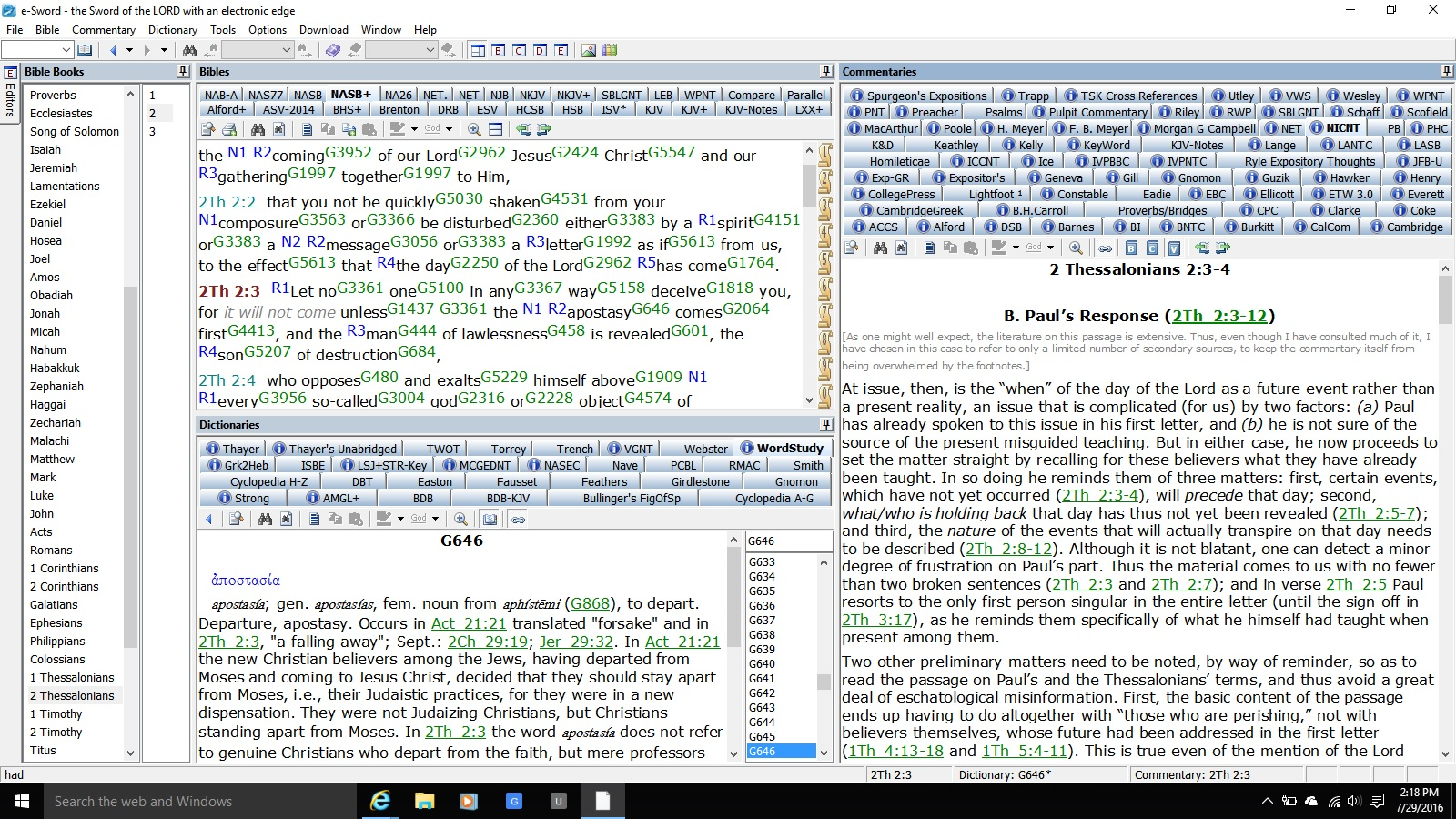
In case you are interested in how I am currently using the program, here is a screenshot of the passage I am studying as I plan to teach through 1 and 2 Thessalonians in the near future:


Click on the screenshot in order to enlarge it, and you can see that I have purchased a few modules but also that I have many modules that I have downloaded for free from BibleSupport.com. The commentary module I have selected in the commentary pane on the right side of the picture is the NICNT module, the commentary is by Gordon Fee.

Wednesday, July 27, 2016

Parable of the Budding Fig Tree (Mark 13:28-31 Teaching Outline)

Introduction: As our Lord Jesus prepared to ascend to the Father, His disciples still did not fully understand all that He had taught them concerning the kingdom of God, so they asked Him, “Lord, will You at this time restore the kingdom to Israel?” (Acts 1:6b). Jesus’ reply was one which we should all take to heart whenever we seek to understand the future fulfillment of His kingdom promises:
NKJ Acts 1:7-8 And He said to them, “It is not for you to know times or seasons which the Father has put in His own authority. 8 But you shall receive power when the Holy Spirit has come upon you; and you shall be witnesses to Me in Jerusalem, and in all Judea and Samaria, and to the end of the earth.”
Of course, Jesus had promised them at an earlier time that “the Helper, the Holy Spirit, whom the Father will send in My name, He will teach you all things, and bring to your remembrance all things that I said to you” (John 14:26). Yet, as we have seen, before His ascension Jesus made it clear that the things the Holy Spirit would bring to remembrance and teach them would not include the “times or seasons which the Father has put in His own authority.”
 
In fact, Jesus had stressed the same idea when He taught the disciples about His second coming in the passage before us. After prophesying about His return and the events that would precede it, Jesus taught the Parable of the Budding Fig Tree. Then, right after the teaching and application of the parable, He said, “But of that day and hour no one knows, not even the angels in heaven, nor the Son, but only the Father” (vs. 32). This is an issue we will consider more next week. For now I will just say that it is one of the reasons why I am not going to spend time this morning trying to understand all the specific details of the prophecy leading up to the teaching of the parable.
 
Although we will try to get a good basic understanding of what our Lord Jesus was saying, our focus will only be on seeking an understanding sufficient for the task of properly understanding the parable itself and Jesus’ intended application of it. With this in mind, we shall examine 1) the context of the parable, 2) the communication of the parable, and 3) the application of the parable.
 
I. Context of the Parable
 
As I have already indicated, the Parable of the Budding Fig Tree follows immediately after a significant section of future prophecy given by our Lord Jesus. This teaching was given in response to a question asked by the disciples after Jesus foretold the destruction of the temple and the surrounding buildings:
NKJ Mark 13:1-4 “Then as He went out of the temple, one of His disciples said to Him, ‘Teacher, see what manner of stones and what buildings are here!’ 2 And Jesus answered and said to him, ‘Do you see these great buildings? Not one stone shall be left upon another, that shall not be thrown down.’ 3 Now as He sat on the Mount of Olives opposite the temple, Peter, James, John, and Andrew asked Him privately, 4 ‘Tell us, when will these things [ταῦτα, taũta] be? And what will be the sign when all these things [ταῦτα … πάντα, taũta … pánta] will be fulfilled?’”
In the first part of His answer, Jesus speaks about the destruction of the temple, which focuses primarily on the future destruction of Jerusalem, which we now know took place in their lifetimes. We see this in verses 5-23:
NKJ Mark 13:5-23 And Jesus, answering them, began to say: “Take heed that no one deceives you. 6 For many will come in My name, saying, 'I am He,' and will deceive many. 7 But when you hear of wars and rumors of wars, do not be troubled; for such things must happen, but the end is not yet. 8 For nation will rise against nation, and kingdom against kingdom. And there will be earthquakes in various places, and there will be famines and troubles. These [ταῦτα, taũta] are the beginnings of sorrows. 9 But watch out for yourselves, for they will deliver you up to councils, and you will be beaten in the synagogues. You will be brought before rulers and kings for My sake, for a testimony to them. 10 And the gospel must first be preached to all the nations. 11 But when they arrest you and deliver you up, do not worry beforehand, or premeditate what you will speak. But whatever is given you in that hour, speak that; for it is not you who speak, but the Holy Spirit. 12 Now brother will betray brother to death, and a father his child; and children will rise up against parents and cause them to be put to death. 13 And you will be hated by all for My name's sake. But he who endures to the end shall be saved. 14 So when you see the 'abomination of desolation,' spoken of by Daniel the prophet [Dan. 9:27], standing where it ought not” (let the reader understand), “then let those who are in Judea flee to the mountains. 15 Let him who is on the housetop not go down into the house, nor enter to take anything out of his house. 16 And let him who is in the field not go back to get his clothes. 17 But woe to those who are pregnant and to those who are nursing babies in those days! 18 And pray that your flight may not be in winter. 19 For in those days there will be tribulation [θλῖψις, thlípsis], such as has not been since the beginning of the creation which God created until this time, nor ever shall be. 20 And unless the Lord had shortened those days, no flesh would be saved; but for the elect's sake, whom He chose, He shortened the days. 21 Then if anyone says to you, 'Look, here is the Christ!' or, 'Look, He is there!' do not believe it. 22 For false christs and false prophets will rise and show signs and wonders to deceive, if possible, even the elect. 23 But take heed; see, I have told you all things [πάντα, pánta, recall vs. 4] beforehand.”
In the second part of His answer, Jesus focuses on His second coming and the cosmic events which will accompany His return. We see this in verses 24-27:
NKJ Mark 13:24-27 But [ἀλλά, allá] in those days, after [cf. Matt. 24:29, “immediately after,” but the emphasis here is more pecisely on the tribulation that would occur within that generation] that tribulation [θλῖψις, thlípsis], the sun will be darkened, and the moon will not give its light; 25 the stars of heaven will fall, and the powers in the heavens will be shaken. 26 Then they will see the Son of Man coming in the clouds with great power and glory. 27 And then He will send His angels, and gather together His elect from the four winds, from the farthest part of earth to the farthest part of heaven.
Thus Jesus has taught about a time of terrible tribulation that would come upon Jerusalem, and He has indicated that sometime after this terrible tribulation period, He will return, and there will be amazing cosmic signs which will accompany His return. It is this teaching about the future which leads to His communication of the Parable of the Budding Fig Tree, to which we will now turn our attention.
 
II. The Communication of the Parable
 
We see the communication of this parable in verse 28:
NKJ Mark 13:28 Now learn this parable [παραβολή, parabolē, ESV = lesson] from the fig tree: When its branch has already become tender, and puts forth leaves, you know that summer is near.
 As the Translator’s Handbook on the Gospel of Mark explains, “in the springtime the sap, rising through the limbs, makes tender the branch which has been stiff and dry through the winter, causing the leaves to sprout” (p. 417).
 
This is something that was common knowledge in first century Palestine, where there were so many fig trees. So, the parable is actually very simple, isn’t it? It is a basic analogy from nature that is used to make a point. Just as one may easily tell that summer is near when he sees the fig tree begin to sprout leaves, even so the believers living in Jerusalem could know that its destruction was near when they saw the signs Jesus had described. Jesus made this point even more clearly when He Himself applied the parable to His hearers.
 
III. The Application of the Parable
 
We see Jesus' application of the parable beginning in verse 29: 
NKJ Mark 13:29 So you also, when you see these things [ταῦτα, taũta] happening, know that it [as in the KJV and NIV; ESV and NASB = he/He] is [Pres. Act. Ind. 3S > εἰμί, eimí], near – at the doors [or gates]! [Note: There is no pronoun in the Greek text in the clause it is near; the pronoun is implied in the verb and must be supplied. In this case it could be either a masculine or a neuter pronoun.] 
Some of you may have a slightly different translation of this verse. For example, the ESV translates the verse this way:
ESV Mark 13:29 So also, when you see these things taking place, you know that he is near, at the very gates. [Italics mine.]
This translation understands Jesus as referring to the fact that, when they see these things, they may know that He Himself is near, whereas the New King James Version understands Jesus as referring to the nearness of the destruction of Jerusalem that He has also just foretold. The Greek text can actually be understood either way, depending on how one understands the context. For example, to what do the words “these things” refer? Well, here is where our brief rehearsal of the preceding context will prove fruitful, for Jesus is referring back to what He had said in His earlier prophecy, where his disciples had used the phrase these things in their question about the coming destruction of Jerusalem. Remember, for example, that, after Jesus said that “Not one stone shall be left upon another, that shall not be thrown down” (vs. 2), His disciples had asked, “when will these things be? And what will be the sign when all these things will be fulfilled?” (vs. 4, italics mine). Thus Jesus uses the same language here that the disciples had used in asking about the destruction of the temple.
 
I think William Lane makes an excellent point when he observes regarding these things referred to in verse 29 and all these things referred to in verse 30 that, “They cannot have reference to the cosmic dissolution described in verses 24-25 since these are phenomena which accompany the parousia [second coming of Christ], not preliminary events which point to it. These things in verse 29 refers to the entire discourse from verses 5-23, with special reference to verses 14-23” (NICNT, e-Sword).
 
The ESV Study Bible also favors this interpretation when it states in the notes corresponding to this passage that “‘These things’ probably refers not to the events of 13:24-27 (for they are the end) but the events of vv. 5-23” (BibleWorks). So, although the ESV translation understands the clause as properly being translated He is near, the notes in the ESV Study Bible apparently disagree and understand the clause as better rendered it is near.
 
So, when Jesus speaks of these things, He is referring to the first part of His answer in the preceding context rather than to the second part. That this is the best way to understand what Jesus is talking about is reinforced by what He says next.
NKJ Mark 13:30 Assuredly, I say to you, this generation [ἡ γενεὰ αὕτη, hē geneà haútē] will by no means pass away till all these things [πάντα ταῦτα, pánta taũta] take place.
Again we see that Jesus uses language that hearkens back to the questions His disciples had asked about the destruction of the temple – which turns out to be about the destruction of Jerusalem as well – when He speaks of “all these things.” But here Jesus makes it clear that these things will happen within the lifetimes of the people to whom He is speaking. He specifically says that “this generation” will not pass away until these things take place. This means that we were right to understand the words these things as a reference not to Jesus’ second coming which had just been prophesied by Him, and which has yet to take place, but rather as a reference to the coming destruction of Jerusalem which had also just been prophesied by Him, and which we know did take place within the lifetime of that generation, because it happened in AD 70.
 
Now, some people take Jesus not to be referring to the generation alive in the first century but to a future generation yet to be born, but that is not the most obvious reading of the text. In addition, the interpretation I have offered reflects the way Jesus had referred to that generation on several earlier occasions. For example:
NKJ Mark 8:11-12 Then the Pharisees came out and began to dispute with Him, seeking from Him a sign from heaven, testing Him. 12 But He sighed deeply in His spirit, and said, “Why does this generation [ἡ γενεὰ αὕτη, hē geneà haútē] seek a sign? Assuredly, I say to you, no sign shall be given to this generation [τῇ γενεᾷ ταύτῃ, tē geneã haútē].”
NKJ Mark 8:31-38 And He began to teach them that the Son of Man must suffer many things, and be rejected by the elders and chief priests and scribes, and be killed, and after three days rise again. 32 He spoke this word openly. And Peter took Him aside and began to rebuke Him. 33 But when He had turned around and looked at His disciples, He rebuked Peter, saying, “Get behind Me, Satan! For you are not mindful of the things of God, but the things of men.” 34 When He had called the people to Himself, with His disciples also, He said to them, “Whoever desires to come after Me, let him deny himself, and take up his cross, and follow Me. 35 For whoever desires to save his life will lose it, but whoever loses his life for My sake and the gospel's will save it. 36 For what will it profit a man if he gains the whole world, and loses his own soul? 37 Or what will a man give in exchange for his soul? 38 For whoever is ashamed of Me and My words in this adulterous and sinful generation [τῇ γενεᾷ ταύτῃ τῇ μοιχαλίδι καὶ ἁμαρτωλω, tē geneã haútē moichalídi kai hamartōlō], of him the Son of Man also will be ashamed when He comes in the glory of His Father with the holy angels.”
NKJ Mark. 9:17-19 Then one of the crowd answered and said, “Teacher, I brought You my son, who has a mute spirit. 18 And wherever it seizes him, it throws him down; he foams at the mouth, gnashes his teeth, and becomes rigid. So I spoke to Your disciples, that they should cast it out, but they could not.” 19 He answered him and said, “O faithless generation [γενεὰ ἄπιστος, geneà ápistos], how long shall I be with you? How long shall I bear with you? Bring him to Me.”
Now, it may be that the tribulation that took place in AD 70 in association with the destruction of Jerusalem was only a foreshadowing of yet another future period of tribulation that will precede the second coming of Christ. This is my own view on the matter. In fact, I think a dual fulfillment, with one in the near future and one in the distant future immediately preceding the return of our Lord Jesus, is the best way to explain the complexities and difficulties in understanding these prophecies and the parallel accounts in Mathew 24 and Luke 21. But that is an issue for another time. For now I will just say that I don’t see how there there can be any doubt that, when Jesus said “this generation will by no means pass away till all these things take place,” He intended a near future fulfillment in the lifetimes of those who heard His teaching.
 
So, Jesus was warning them that all they once knew as most important in their lives as Jews under the Old Covenant would soon be passing away. But what was really most important would never pass away, as He went on to make clear.
NKJ Mark 13:31 Heaven and earth will pass away, but My words will by no means pass away.
This would have been a very startling statement to anyone who had not already accepted Jesus as the divine Son of God, for in it Jesus claims for His own words what can only be said of the words of God Himself. In fact, the statement reflects Old Testament language about the Word of God. As Isaiah said, “The grass withers, the flower fades, but the word of our God stands forever” (Isa. 40:8).
 
The reason that God’s Word stands forever is, of course, because God Himself endures forever, as the Psalmist says:
NKJ Psalm 102:24-27 I said, “O my God, do not take me away in the midst of my days; Your years are throughout all generations. 25 Of old You laid the foundation of the earth, and the heavens are the work of Your hands. 26 They will perish, but You will endure; yes, they will all grow old like a garment; like a cloak You will change them, and they will be changed. 27 But You are the same, and Your years will have no end.”
As William Lane put it, “While heaven and earth will be cataclysmically destroyed, Jesus’ word is established forever. This claim of high dignity for Jesus’ words implies a christological affirmation: what is said of God in the OT may be equally affirmed of Jesus and his word” (NICNT, e-Sword)
 
Jesus’ statement here is therefore just one more way in which He assumed His own deity and equality with God the Father in His teaching. In this case, however, He stresses this fact so that we may be confident that His words will indeed come to pass. We can be sure that, no matter what terrible things happen in our lives, or no matter how many changes we see taking place all around us, the word of our Lord is a sure foundation upon which to build our lives.
 
Conclusion: So, what are the primary lessons our Lord Jesus wants us to take away from His teaching and application of this parable? I would suggest at least three.
 
First, we can trust that the future is firmly in the hands of our sovereign Lord. Nothing will take Him by surprise. Even the terrible tribulations and sorrows of this life serve His greater purpose. As the Apostle Paul taught us, “we know that all things work together for good to those who love God, to those who are the called according to His purpose” (Rom. 8:28). We should not fret, then, as we see things disintegrating all around us and as we watch the judgment of God upon our culture.
 
Second, since our Lord knows the future, and nothing takes Him by surprise, He is able to warn us about things to come so that we may be prepared to face them. Despite the fact that we cannot know the “times or seasons which the Father has put in His own authority” (Acts 1:7), we can know certain signs of the times that will help us to be prepared for the terrible things to come, and we can become well acquainted with His ways so that we can understand how He often works in the world and therefore not be surprised or hindered in our faith. As the Apostle Peter said:
NKJ 1 Peter 4:12-13 Beloved, do not think it strange concerning the fiery trial which is to try you, as though some strange thing happened to you; 13 but rejoice to the extent that you partake of Christ's sufferings, that when His glory is revealed, you may also be glad with exceeding joy.
Third, we can rely upon the Word of our sovereign Lord as the sure foundation for our lives and our future hope. As our Lord Jesus said in the Parable of the Wise and Foolish Builders:
NKJ Matthew 7:24-27 Therefore whoever hears these sayings of Mine, and does them, I will liken him to a wise man who built his house on the rock: 25 and the rain descended, the floods came, and the winds blew and beat on that house; and it did not fall, for it was founded on the rock. 26 But everyone who hears these sayings of Mine, and does not do them, will be like a foolish man who built his house on the sand: 27 and the rain descended, the floods came, and the winds blew and beat on that house; and it fell. And great was its fall.
This leaves each of us with a decision to make. Will we trust in our Lord Jesus and His Word, or will we try to build our lives on the shifting sands of the world and its lies?